
PIECE
An up-to-date measure of economics and disadvantage
PIECE
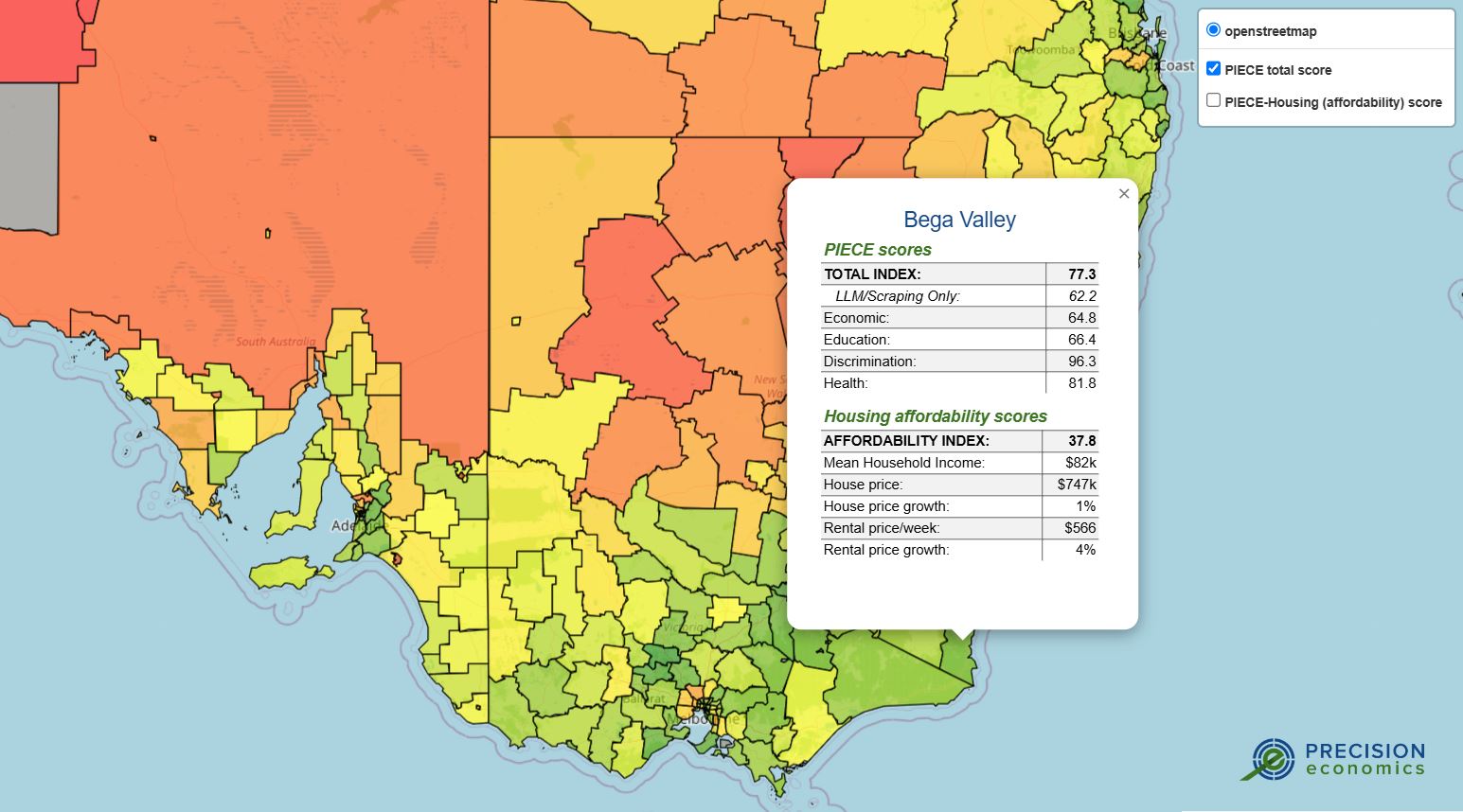
PIECE provides an up-to-date estimate (measured as a relative index, constructed using nested principal components analysis, PCA) of aggregate opportunities and disadvantages faced by people living throughout Australia (in all Local Government Areas, LGAs). Our Broadly, it focusses on economic capability, education levels, sources of discrimination, and health.
PIECE is based on traditional data taken from the latest Census, as well as data recently scraped from the web and processed by LLMs, to factor in changes that have occurred since the Census.
Our PIECE-Housing score shows the relative affordability of home ownership and rentals in the LGA.
TOPICS IN OUR INDEXES
- Economic: How strong are the economic opportunities and capabilities of people within the area? This reflects people’s earnings, assets and wealth, and employment.
- Education: What are educational opportunities and levels like in the area? This reflects qualifications, study, and accessibility of institutions.
- Discrimination: How common are historically disadvantaged and discriminated-against groups? This reflects labour market attachment, CALD considerations, gender, age and indigeneity.
- Health: How strong is the health of people in the area? This reflects the frequency of health conditions and disabilities, children and the elderly, indigeneity and access to health services.
- Housing: How difficult is home ownership and renting in the area? This reflects the levels of prices and rents, as well as the quantity and frequency of listings of houses, units and rentals in the area (as well as their attributes), and how those things have changed over time.
DATA SOURCES
- Traditional data: Each of the four topics includes a number of variables taken from the latest Census (2021). Some of the variables are mentioned in the brief descriptions on the left, more information can be provided on request.
- Web-scraping and machine learning: For each of the four topics, data was scraped from the web to provide information about each area (for example, to gain additional information about tertiary institutions, or availability of GPs and hospitals). These unstructured data were assessed by several LLMs (to reduce the chance of hallucination), quantised, and averaged.
- Future expansions: Future work will expand the traditional data sources included in the index, and improve the ML data.
 Precision Economics